<- From
Instead of simply limiting the number of wheels that the child has, we could allow her to have the wheels, but not allow her to use them to make cars. We can do this in a few ways.
First, we can sequester the wheels, perhaps by putting them all in a bag that she can’t open. Second, we can stick something to each of the wheels so that they won’t fit into the cars. Finally, we can stick something into the cars so that the wheels no longer fit. The body uses each of these methods as well.
Showing posts with label science. Show all posts
Showing posts with label science. Show all posts
Friday, November 26, 2010


The Lego® Model of Pharmacology
In understanding drugs and how they work, it can be helpful to think of the body and its atoms as a giant set of Lego® bricks[1]. A child can use Lego® bricks to make buildings, space ships, cars, etc; and the body can use its atoms to build muscles, bones, signaling molecules, etc. Moreover, just as the child can disassemble her building and then use the bricks to make a car, the body can disassemble its muscle and build bone. Of course, the car requires special bricks (e.g. wheels) which aren’t needed to make a building, and bone needs special atoms (e.g. calcium) which aren’t needed to make a muscle: the number of cars the child can make is limited by the number of wheels she has, and the amount of bone the body can make is limited by the amount of calcium available.
This last point is important. It means that if we want to regulate the number of cars that the child makes, we only need to regulate the number of wheels we allow her to use. We might do this because we have too many cars, and don’t want any more, or we might do so because we don’t have enough buildings (or space ships, or bridges) and want to conserve our bricks to make those instead of cars.
In the body, if we want to regulate the amount of bone we make, we can regulate the amount of calcium there is to make it with. We might do this because we have too much bone, and don’t want any more, or we might do so because we don’t have enough of something else, and want to conserve building materials to make, say, muscle.
Pharmacology (the science of drugs) manipulates the body by interfering with the way it uses its atoms. Continuing with the Lego analogy, drugs are the equivalent of another person adding or removing bricks to the buildings, cars, space ships, etc as they’re being built or after they’re finished; or adding or removing bricks from the box of unused bricks.
[1] Lego® is a registered trademark of the LEGO® Group of companies, which does not sponsor, authorise, or endorse this site
This last point is important. It means that if we want to regulate the number of cars that the child makes, we only need to regulate the number of wheels we allow her to use. We might do this because we have too many cars, and don’t want any more, or we might do so because we don’t have enough buildings (or space ships, or bridges) and want to conserve our bricks to make those instead of cars.
In the body, if we want to regulate the amount of bone we make, we can regulate the amount of calcium there is to make it with. We might do this because we have too much bone, and don’t want any more, or we might do so because we don’t have enough of something else, and want to conserve building materials to make, say, muscle.
Pharmacology (the science of drugs) manipulates the body by interfering with the way it uses its atoms. Continuing with the Lego analogy, drugs are the equivalent of another person adding or removing bricks to the buildings, cars, space ships, etc as they’re being built or after they’re finished; or adding or removing bricks from the box of unused bricks.
[1] Lego® is a registered trademark of the LEGO® Group of companies, which does not sponsor, authorise, or endorse this site
Saturday, January 24, 2009
Curiosity and intelligence
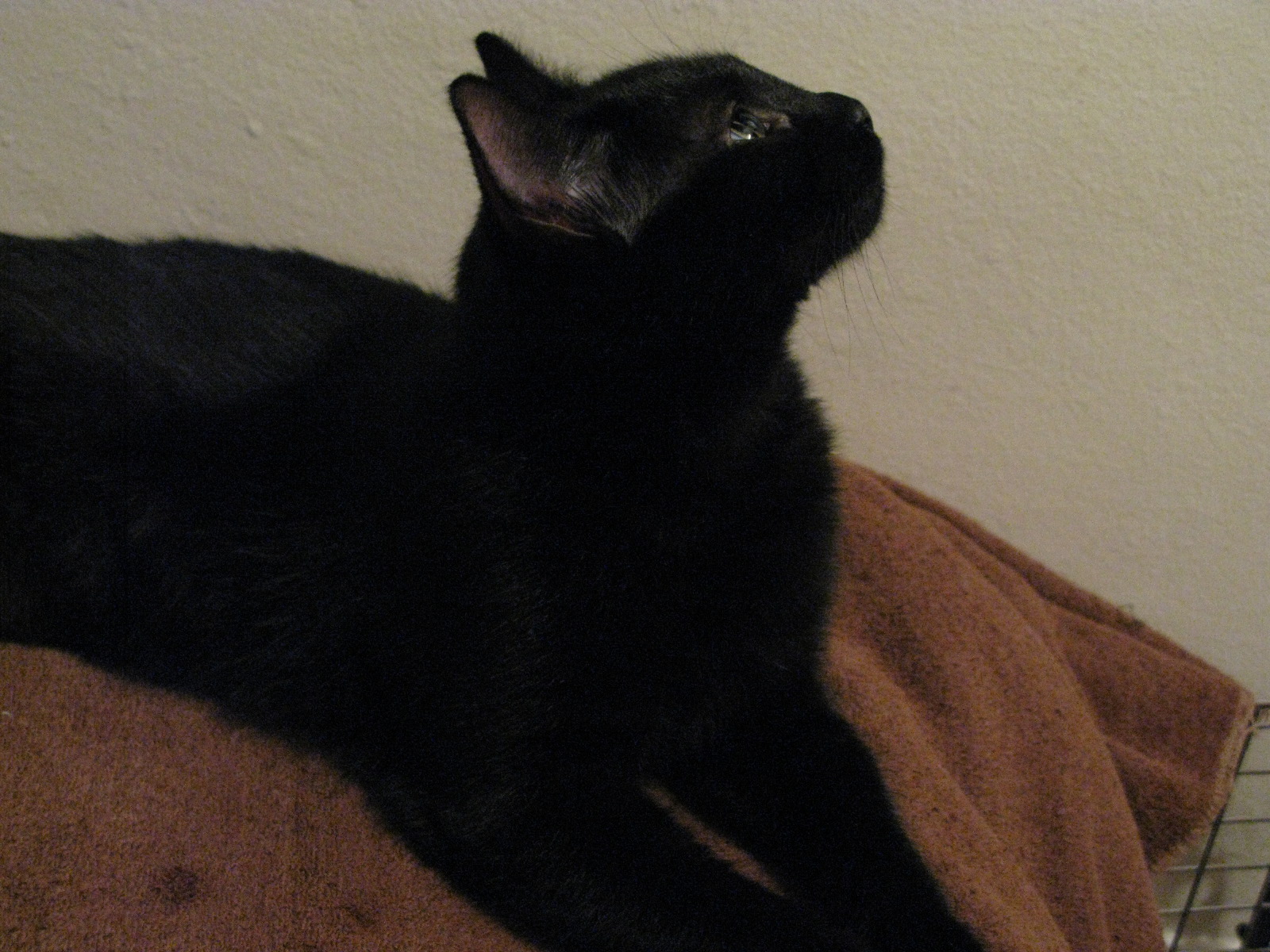
Curious Kitten (who is no longer a kitten, but we'll leave that to one side) has developed a fascination for what might be on top of the dresser. This, along with the top of the TV, is the only place outside of a closet or cabinet that the cats can't get to.
This lead me to think about curiosity generally. Cats are perhaps notoriously inquisitive; the fact that curiosity killed the cat is a cliche', testifies to that. People are also curious. Dogs are curious. Dolphins are, too. These are also intelligent species.
Does curiosity lead to, or require intelligence? Indulging in curiosity involves risk; it can lead on into dangerous situations where intelligence needed to survive - would evolution therefor tend to favor those who are both curious and intelligent, rather than just curious.
Not sure how to test that, though.
This lead me to think about curiosity generally. Cats are perhaps notoriously inquisitive; the fact that curiosity killed the cat is a cliche', testifies to that. People are also curious. Dogs are curious. Dolphins are, too. These are also intelligent species.
Does curiosity lead to, or require intelligence? Indulging in curiosity involves risk; it can lead on into dangerous situations where intelligence needed to survive - would evolution therefor tend to favor those who are both curious and intelligent, rather than just curious.
Not sure how to test that, though.
Thursday, January 15, 2009
Crib sheet
For those who need to brush up an a few basics:
source: http://dontclickthis.whatingods.name/cribsheet9.gif

source: http://dontclickthis.whatingods.name/cribsheet9.gif
Thursday, November 20, 2008
Wolfram's Rule 34 (XKCD)
If I understood it myself, I'd explain it, but here are a few spam-free links that discuss it:
http://stackoverflow.com/questions/302369/wolframs-rule-34-in-xkcd
http://fakerake.com/2008/282/wolframs-rule-34-for-xkcd-readers/
http://atlas.wolfram.com/01/01/34/01_01_1_34.html
The 1st includes the 2nd and 3rd, as well as some others.
The original comic: http://www.xkcd.com/505/
http://stackoverflow.com/questions/302369/wolframs-rule-34-in-xkcd
http://fakerake.com/2008/282/wolframs-rule-34-for-xkcd-readers/
http://atlas.wolfram.com/01/01/34/01_01_1_34.html
The 1st includes the 2nd and 3rd, as well as some others.
The original comic: http://www.xkcd.com/505/
Monday, September 15, 2008
He'd rather be the product of a creationary God
"I have long been at a loss to understand how it is possible to believe the evolutionary theory, riddled with holes and inconsistencies as it is, more that the creationist view. The facts we see in front of us fit the notion of a rapid creationist view far better than a long evolutionary one, and why the evolutionary theory is considered to be "science" but the creationist theory is not eludes me completely. It was partly a serious study of evolution that led me to conclude that I'd rather be the product of a creationary God than an evolutionary accident, and so embrace Christianity. I am so pleased I did, life has become so much less gloomy.
Robert Harper, Battle, England"
The above is from the comments section at http://news.bbc.co.uk/2/hi/uk_news/magazine/7613403.stm
I'm happy that Mr Harper's life has become less gloomy, but I suspect that it is not Christianity that has improved his life so much as either belonging to a group or having something to believe in - perhaps even a shifting of responsibility away from himself.
The debate over creationism is an curious one, for just the reasons that Mr Harper points out. His belief in Creation comes down to what he wants to believe, rather than what objectivity suggests. Mr Harper doesn't discuss this, but I suspect that he'd rather there be a Santa Claus than that there not be one. I'm curious to know what he does at Christmas time.
The problem with creationism has nothing to do with Creation: it has to do with the difference between religion and science. Science allows for debate. Religion, at least in this case, does not.
Tuesday, July 8, 2008
WALL-E
I saw WALL-E last weekend (the weekend before the 4th, that is). This movie has had a long period of advance advertising, with cardboard WALL-E models in theater lobbies and such, and when I first saw those models, I thought that this was a sort of cartoony Short Circuit, and I wasn't really interested. Even when I learned that it was from Pixar, I wasn't intrigued, which indicates a shortcoming on my part, since Pixar generally puts out a good, thought-provoking product. But I caught a review in the paper (The New York Times, I think) and leared that the movie, though animated, digs into some very real issues: what is the likely outcome if we human beings continue in our present path of consumerism and laziness. The outcome is potentially bleak, and all the more so as we don't really seem to notice what it is that we're losing. Just now, for instance, in one of my rare free moments, I'm sitting here at the computer blogging instead of playing with my ca
Tuesday, May 27, 2008
Wave, particle, photon
Light is a puzzling thing, since it exhibits behaviors of a particle, and of a wave. David Morgan-Mar includes an interesting, understandable (that is, I understand what he's saying, though some of the finer points of the phenomenon escape me) discussion of this as part of his annotations on this strip: http://www.irregularwebcomic.net/1944.html
You may need to scroll down a bit.
You may need to scroll down a bit.
Monday, April 21, 2008
Subscribe to:
Posts (Atom)