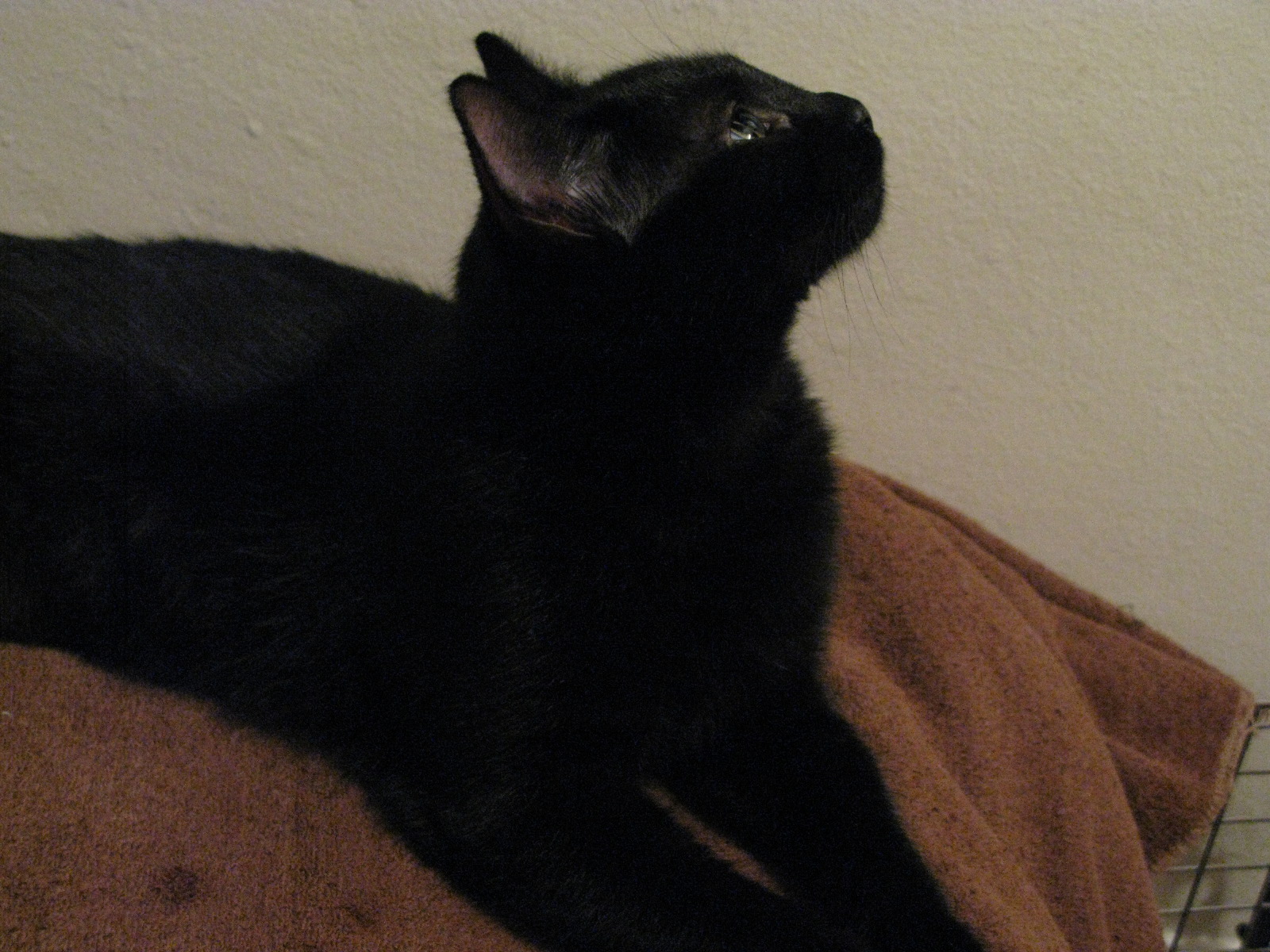
Curious Kitten (who is no longer a kitten, but we'll leave that to one side) has developed a fascination for what might be on top of the dresser. This, along with the top of the TV, is the only place outside of a closet or cabinet that the cats can't get to.
This lead me to think about curiosity generally. Cats are perhaps notoriously inquisitive; the fact that curiosity killed the cat is a cliche', testifies to that. People are also curious. Dogs are curious. Dolphins are, too. These are also intelligent species.
Does curiosity lead to, or require intelligence? Indulging in curiosity involves risk; it can lead on into dangerous situations where intelligence needed to survive - would evolution therefor tend to favor those who are both curious and intelligent, rather than just curious.
Not sure how to test that, though.
Showing posts with label evolution. Show all posts
Showing posts with label evolution. Show all posts
Saturday, January 24, 2009


Monday, September 15, 2008
He'd rather be the product of a creationary God
"I have long been at a loss to understand how it is possible to believe the evolutionary theory, riddled with holes and inconsistencies as it is, more that the creationist view. The facts we see in front of us fit the notion of a rapid creationist view far better than a long evolutionary one, and why the evolutionary theory is considered to be "science" but the creationist theory is not eludes me completely. It was partly a serious study of evolution that led me to conclude that I'd rather be the product of a creationary God than an evolutionary accident, and so embrace Christianity. I am so pleased I did, life has become so much less gloomy.
Robert Harper, Battle, England"
The above is from the comments section at http://news.bbc.co.uk/2/hi/uk_news/magazine/7613403.stm
I'm happy that Mr Harper's life has become less gloomy, but I suspect that it is not Christianity that has improved his life so much as either belonging to a group or having something to believe in - perhaps even a shifting of responsibility away from himself.
The debate over creationism is an curious one, for just the reasons that Mr Harper points out. His belief in Creation comes down to what he wants to believe, rather than what objectivity suggests. Mr Harper doesn't discuss this, but I suspect that he'd rather there be a Santa Claus than that there not be one. I'm curious to know what he does at Christmas time.
The problem with creationism has nothing to do with Creation: it has to do with the difference between religion and science. Science allows for debate. Religion, at least in this case, does not.
Saturday, July 26, 2008
The spider and the bee
Shadow is presently fiercely watching, and occasionally trying to pounce on a bee. The bee is outside, so she can't get it, of course, otherwise I'd intervene - Shadow doesn't need to be stung on the nose or mouth. But her harmless pounces have drawn my attention to the plight of this bee, which has caught one of its legs in a spiderweb.
The bee is desperate. It alternately tries to pull itself away by walking and by flying. Neither work. The spider, from its safe location on the far side of the web, watches patiently: the bee is to strong for the moment. Some minutes or hours of struggle will wear it down, and I expect that the spider will then move in to finish the bee off.
And I am faced with a decision. It would be very easy to open the window, cut the web, and release the bee. But our interference in matters like this is rarely beneficial, except in as much as we sympathize with the bee, and feel better once we set it free, as if we've done something to make the world a better, fairer place.
We haven't, of course. We free the bee, and the spider suffers. What is more, how is it that the bee should be valued over the spider? Or the spider over the bee? Gary Larson wrote on this subject in There's a Hair in my Dirt, the story of Harriet, who loved all creatures (all cute, furry ones, at least) and did all she could for them. In each case she freed the bee, and ultimately, she makes the world a worse place for it. There is a balance between bees and spiders.
So do I give in to the emotions and free the bee, or give in to my reasoning and leave it to its death? Either way, I'm not exactly happy.
Postscript: Turns out that the bee escaped on its own, so all this was for nothing.
The bee is desperate. It alternately tries to pull itself away by walking and by flying. Neither work. The spider, from its safe location on the far side of the web, watches patiently: the bee is to strong for the moment. Some minutes or hours of struggle will wear it down, and I expect that the spider will then move in to finish the bee off.
And I am faced with a decision. It would be very easy to open the window, cut the web, and release the bee. But our interference in matters like this is rarely beneficial, except in as much as we sympathize with the bee, and feel better once we set it free, as if we've done something to make the world a better, fairer place.
We haven't, of course. We free the bee, and the spider suffers. What is more, how is it that the bee should be valued over the spider? Or the spider over the bee? Gary Larson wrote on this subject in There's a Hair in my Dirt, the story of Harriet, who loved all creatures (all cute, furry ones, at least) and did all she could for them. In each case she freed the bee, and ultimately, she makes the world a worse place for it. There is a balance between bees and spiders.
So do I give in to the emotions and free the bee, or give in to my reasoning and leave it to its death? Either way, I'm not exactly happy.
Postscript: Turns out that the bee escaped on its own, so all this was for nothing.
Tuesday, July 8, 2008
WALL-E
I saw WALL-E last weekend (the weekend before the 4th, that is). This movie has had a long period of advance advertising, with cardboard WALL-E models in theater lobbies and such, and when I first saw those models, I thought that this was a sort of cartoony Short Circuit, and I wasn't really interested. Even when I learned that it was from Pixar, I wasn't intrigued, which indicates a shortcoming on my part, since Pixar generally puts out a good, thought-provoking product. But I caught a review in the paper (The New York Times, I think) and leared that the movie, though animated, digs into some very real issues: what is the likely outcome if we human beings continue in our present path of consumerism and laziness. The outcome is potentially bleak, and all the more so as we don't really seem to notice what it is that we're losing. Just now, for instance, in one of my rare free moments, I'm sitting here at the computer blogging instead of playing with my ca
Monday, April 21, 2008
Saturday, April 19, 2008
Ben Stein: appropriately Expelled
Scientific American recently reviewed Ben Stein's new movie, Expelled: No Intelligence Allowed. The review, and even more so, the comments that follow it, are enlightening. In fairness, though, before I go further, I should note that I have not seen the movie, nor have I read any of Darwin's work. Nevertheless, I think that some comments can be made based on what I see in the review and its replies.
I'll start by defining science and religion as I understand them, as those terms, and their meaning, seem to play a large part in this debate. Both purport to explain the workings of the world around us, and so on that level, they are comparable. The difference, as I see it, is that while religion tells us "this is how things work," science is less absolute, saying only "this is our best understanding of how things work - new information may result in new theories". In other words, science encourages debate into the validity of its theories, with the understanding that debate and challenge will bring it closer to understanding the truth, while religion tells us what truth is, and has no mechanism for evaluating or updating its views. Admittedly, the degree to which science is open to challenge and revision varies - anyone looking to challenge the theory of gravity, for instance, will be hard-pressed to find support - but the theoretical basis of science is the scientific method, which includes challenge and revision as main tenets.
But, on to Ben Stein and Expelled. Stein proposes that educators and scientists who dare mention intelligent design are being shut out of the discussion on the origins of mankind. As part of this argument he compares proponents of evolution to Nazis, and apparently claims that Charles Darwin's theories led to the rise of Nazi Germany and the Holocaust. The difficulty with this argument would be that it confuses inspiration with responsibility. Hitler may have used the theory of evolution as a basis for his own theories, and it may have in fact inspired some of his thinking, but we can't thereofor suggest that people who believe in evolution are akin to Nazis, or that without the theory of evolution, Hitler's Nazism would never have emerged.
Personally, I don't think that Stein truly believes that Charles Darwin is responsible for the crimes of Germany before and during World War II; he's too smart for that. But I do think that he believes that there are people who will believe in that connection, and I agree with him on that, particularly if someone like Ben Stein voices it. In other words, I think Stein is using the Nazis as propaganda in an attempt to connect a phenomenon scorned by much of the country with the theories of evolution. If he can convince people to connect evolution with Nazism, then he can make evolution a very scary thing. This is something like the negative campaigning so often seen in political races, where candidates have little to say about their own qualifications, but a lot to say about their rivals' shortcomings.
I am also reminded of the alar scare during the late 1980s. Lab studies found that alar, a chemical sprayed on apples, caused cancer in lab animals, and eventually public distrust of the chemical caused it to be removed from the market. Whether alar was harmful or not is not my point here (even water is harmful enough in high enough doses), though; my point is that it was a chemical sprayed on apples. What could be a more basic and friendly food than an apple? What could be more healthful? What other food could so easily create a public outcry if it were tampered with and made unsafe? Chemicals more dangerous than alar no doubt were being used in the food industry at the time, but none was as easy a target as alar because alar was sprayed on apples - on the apples that we - and especially our children - eat. By connecting the theory of evolution with Nazism, Stein can elicit a much more vociferous response, in many more people, than if he merely said that the theory was counter to his own beliefs, or was faulty for any number of more plausible, more honest, but less dramatic, reasons.
I'll start by defining science and religion as I understand them, as those terms, and their meaning, seem to play a large part in this debate. Both purport to explain the workings of the world around us, and so on that level, they are comparable. The difference, as I see it, is that while religion tells us "this is how things work," science is less absolute, saying only "this is our best understanding of how things work - new information may result in new theories". In other words, science encourages debate into the validity of its theories, with the understanding that debate and challenge will bring it closer to understanding the truth, while religion tells us what truth is, and has no mechanism for evaluating or updating its views. Admittedly, the degree to which science is open to challenge and revision varies - anyone looking to challenge the theory of gravity, for instance, will be hard-pressed to find support - but the theoretical basis of science is the scientific method, which includes challenge and revision as main tenets.
But, on to Ben Stein and Expelled. Stein proposes that educators and scientists who dare mention intelligent design are being shut out of the discussion on the origins of mankind. As part of this argument he compares proponents of evolution to Nazis, and apparently claims that Charles Darwin's theories led to the rise of Nazi Germany and the Holocaust. The difficulty with this argument would be that it confuses inspiration with responsibility. Hitler may have used the theory of evolution as a basis for his own theories, and it may have in fact inspired some of his thinking, but we can't thereofor suggest that people who believe in evolution are akin to Nazis, or that without the theory of evolution, Hitler's Nazism would never have emerged.
Personally, I don't think that Stein truly believes that Charles Darwin is responsible for the crimes of Germany before and during World War II; he's too smart for that. But I do think that he believes that there are people who will believe in that connection, and I agree with him on that, particularly if someone like Ben Stein voices it. In other words, I think Stein is using the Nazis as propaganda in an attempt to connect a phenomenon scorned by much of the country with the theories of evolution. If he can convince people to connect evolution with Nazism, then he can make evolution a very scary thing. This is something like the negative campaigning so often seen in political races, where candidates have little to say about their own qualifications, but a lot to say about their rivals' shortcomings.
I am also reminded of the alar scare during the late 1980s. Lab studies found that alar, a chemical sprayed on apples, caused cancer in lab animals, and eventually public distrust of the chemical caused it to be removed from the market. Whether alar was harmful or not is not my point here (even water is harmful enough in high enough doses), though; my point is that it was a chemical sprayed on apples. What could be a more basic and friendly food than an apple? What could be more healthful? What other food could so easily create a public outcry if it were tampered with and made unsafe? Chemicals more dangerous than alar no doubt were being used in the food industry at the time, but none was as easy a target as alar because alar was sprayed on apples - on the apples that we - and especially our children - eat. By connecting the theory of evolution with Nazism, Stein can elicit a much more vociferous response, in many more people, than if he merely said that the theory was counter to his own beliefs, or was faulty for any number of more plausible, more honest, but less dramatic, reasons.
Saturday, February 9, 2008
Freeware, free software threaten Microsoft
The New York Times is reporting what many computer users already know: freeware and free software have grown to become a real competitor for Microsoft's products. But the Times goes one step further, and states that it now appears that M'soft is taking notice, though analysts debate how much notice M'soft is actually taking. It's about time.
I say this for a few reasons. First, if M'soft is recognizing that it has real competition, it might pay more attention to quality control. Second, this suggests that Microsoft's monopoly may be starting to crumble, which would be good for competition. I expect there are many programmers who have hitherto refrained from creating or releasing their products because they doubt that they can prise any customers away from M'soft. Third, this also proposes that off-site data holding is becoming increasingly available. Where previously I had to have my floppy disk, Zip disk, laptop or thumb drive with me if I wanted to work on my [insert name of paper or project here], now I merely need an internet connection; the paper is saved on someone else's computer, and I access it through the 'net. Fourth, though I recognize the right of a software developer to charge for his software, I don't enjoy paying for software any more than anyone else. Perhaps even less so than some people, my finances being what they are.
More on this later. I have to go teach cell bio.
I say this for a few reasons. First, if M'soft is recognizing that it has real competition, it might pay more attention to quality control. Second, this suggests that Microsoft's monopoly may be starting to crumble, which would be good for competition. I expect there are many programmers who have hitherto refrained from creating or releasing their products because they doubt that they can prise any customers away from M'soft. Third, this also proposes that off-site data holding is becoming increasingly available. Where previously I had to have my floppy disk, Zip disk, laptop or thumb drive with me if I wanted to work on my [insert name of paper or project here], now I merely need an internet connection; the paper is saved on someone else's computer, and I access it through the 'net. Fourth, though I recognize the right of a software developer to charge for his software, I don't enjoy paying for software any more than anyone else. Perhaps even less so than some people, my finances being what they are.
More on this later. I have to go teach cell bio.
Tuesday, January 29, 2008
Survival of the most valued
Yesterday on NPR, or perhaps the day before, I heard a spot on the domestication of the cat. Current theory proposes that early, proto-domesticated-cats would have been valued for their abilities to catch and destroy vermin. We can also propose that those cats who were encouraged to stay (or at least, not chased away) would have been those who were the most pleasing to the people in need of vermin control. Part of a cat's appeal would be the nature of its voice, and as cat owners know, there is something appealing in [most] house cats' calls. There is something endearing about the timbre, volume, inflection - something about their calls is socially encouraging.
The speaker compared the socially encouraging nature of house cats' voices to those of wildcats in the zoo, which he found sounded "permanently angry". Truthfully, I might be permanently angry if I was incarcerated in a zoo, and I don't know that I've ever seen a zoo inmate that I'd have called happy, but the point for this discussion is that wildcats, which I gather are genetically similar enough to house cats to successfully mate with them, have voices that are much less pleasant to our ears. The proposal, therefor, is that humans have unnaturally selected house cats for their voices, and for other features we find desirable.
At first glance, this may not seem much different than any form of natural selection - those cats whose traits best enabled them to survive in the world of humans flourished, while those cats who always seemed to be pissed-off failed to survive and procreate. But to look at the issue this way overlooks one key difference. This selection of cats was driven by human intervention. There may not have been a plan behind it, but there was definite intent - "oh, this cat is cute and has a pleasant voice; I think I'll feed it and provide it with shelter."
The phenomenon we describe as natural selection looks only at the relationship between the individual and its environment, and does not consider any guiding intelligence on the part of either. In the case of house cats (and dogs, and domesticated species generally) we find an element of intelligent design, for although we cannot design a species from scratch (yet), we can selectively breed individuals to enhance traits we prefer and reduce traits that we don't. We have hijacked Darwin.
Which leads me to a discussion of healthcare. Individuals who in the natural course of events would die without reproducing are allowed, through the tools and techniques of medicine, to survive, and their genes, including those that made them sickly and inclined to die, are preserved in the gene pool. Thus, instead of naturally shedding undesirable, and even harmful, genes; which would keep the gene pool and the species strong; we keep them and make our species as a whole weaker.
If our medical technology ever gives up or out, then we as a species may be doomed.
The speaker compared the socially encouraging nature of house cats' voices to those of wildcats in the zoo, which he found sounded "permanently angry". Truthfully, I might be permanently angry if I was incarcerated in a zoo, and I don't know that I've ever seen a zoo inmate that I'd have called happy, but the point for this discussion is that wildcats, which I gather are genetically similar enough to house cats to successfully mate with them, have voices that are much less pleasant to our ears. The proposal, therefor, is that humans have unnaturally selected house cats for their voices, and for other features we find desirable.
At first glance, this may not seem much different than any form of natural selection - those cats whose traits best enabled them to survive in the world of humans flourished, while those cats who always seemed to be pissed-off failed to survive and procreate. But to look at the issue this way overlooks one key difference. This selection of cats was driven by human intervention. There may not have been a plan behind it, but there was definite intent - "oh, this cat is cute and has a pleasant voice; I think I'll feed it and provide it with shelter."
The phenomenon we describe as natural selection looks only at the relationship between the individual and its environment, and does not consider any guiding intelligence on the part of either. In the case of house cats (and dogs, and domesticated species generally) we find an element of intelligent design, for although we cannot design a species from scratch (yet), we can selectively breed individuals to enhance traits we prefer and reduce traits that we don't. We have hijacked Darwin.
Which leads me to a discussion of healthcare. Individuals who in the natural course of events would die without reproducing are allowed, through the tools and techniques of medicine, to survive, and their genes, including those that made them sickly and inclined to die, are preserved in the gene pool. Thus, instead of naturally shedding undesirable, and even harmful, genes; which would keep the gene pool and the species strong; we keep them and make our species as a whole weaker.
If our medical technology ever gives up or out, then we as a species may be doomed.
Thursday, October 4, 2007
The connection between cats and our bipedal stance
I'm playing with Shadow with a plastic bottle cap. Sometimes I slide or roll it along the floor, other times I bounce it off of the floor or a wall. In her excitement, she sometimes winds up standing on her back legs, as her front legs grapple with the bottle cap.
This is not the first time she's done this, nor is she the only cat I've ever seen do this, but today it occurs to me, as she takes a few steps on her hind legs to keep her balance, that this behavior might in some way be related to our two-legged stance as human beings. Perhaps cats that can successfully stand on their hind legs are better able to catch prey, or something. Carried to an extreme, this would eventually yield fully bipedal creatures.
This is not the first time she's done this, nor is she the only cat I've ever seen do this, but today it occurs to me, as she takes a few steps on her hind legs to keep her balance, that this behavior might in some way be related to our two-legged stance as human beings. Perhaps cats that can successfully stand on their hind legs are better able to catch prey, or something. Carried to an extreme, this would eventually yield fully bipedal creatures.
Subscribe to:
Posts (Atom)