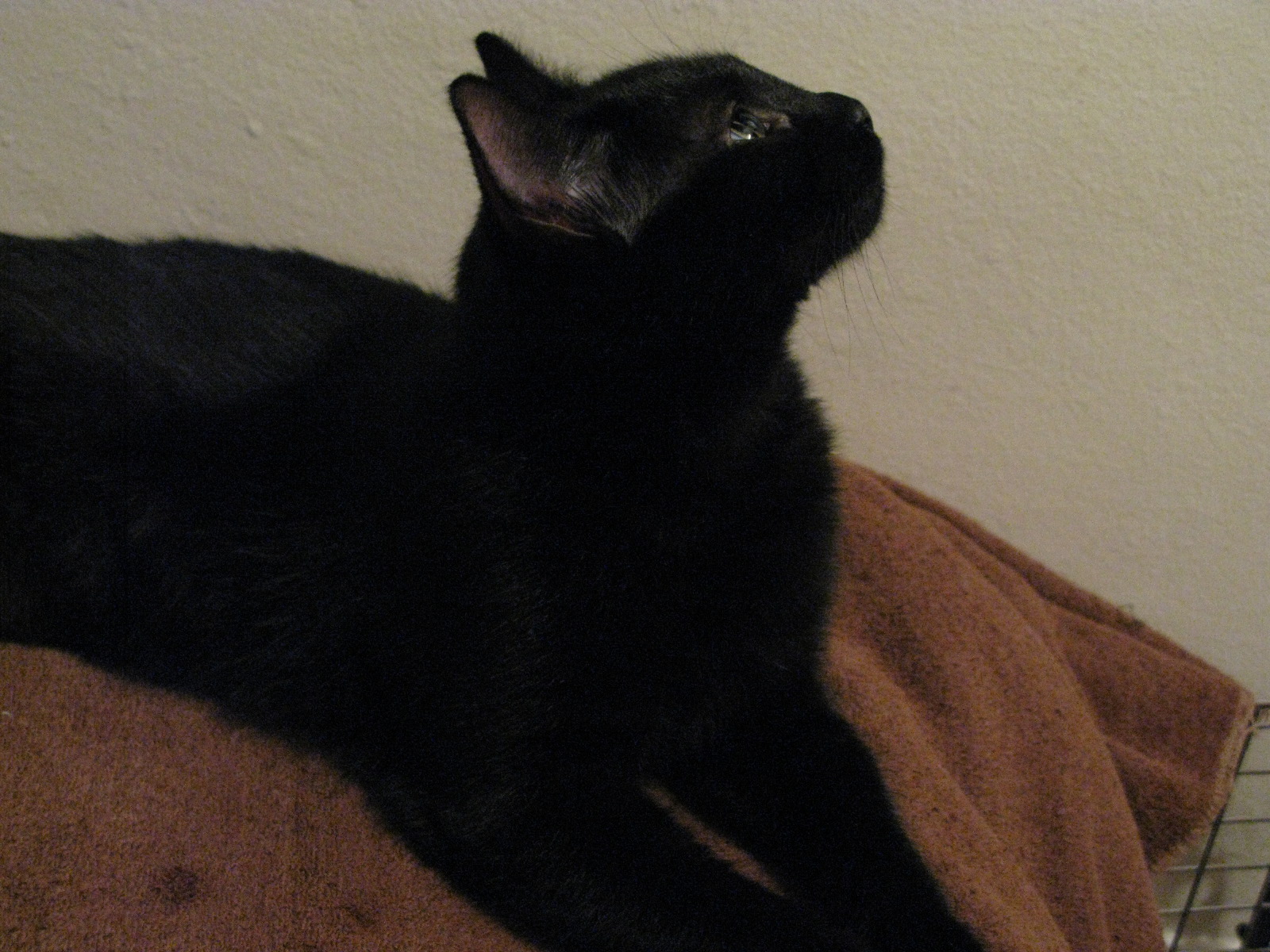
Curious Kitten (who is no longer a kitten, but we'll leave that to one side) has developed a fascination for what might be on top of the dresser. This, along with the top of the TV, is the only place outside of a closet or cabinet that the cats can't get to.
This lead me to think about curiosity generally. Cats are perhaps notoriously inquisitive; the fact that curiosity killed the cat is a cliche', testifies to that. People are also curious. Dogs are curious. Dolphins are, too. These are also intelligent species.
Does curiosity lead to, or require intelligence? Indulging in curiosity involves risk; it can lead on into dangerous situations where intelligence needed to survive - would evolution therefor tend to favor those who are both curious and intelligent, rather than just curious.
Not sure how to test that, though.
Showing posts with label risk. Show all posts
Showing posts with label risk. Show all posts
Saturday, January 24, 2009


Tuesday, July 8, 2008
WALL-E
I saw WALL-E last weekend (the weekend before the 4th, that is). This movie has had a long period of advance advertising, with cardboard WALL-E models in theater lobbies and such, and when I first saw those models, I thought that this was a sort of cartoony Short Circuit, and I wasn't really interested. Even when I learned that it was from Pixar, I wasn't intrigued, which indicates a shortcoming on my part, since Pixar generally puts out a good, thought-provoking product. But I caught a review in the paper (The New York Times, I think) and leared that the movie, though animated, digs into some very real issues: what is the likely outcome if we human beings continue in our present path of consumerism and laziness. The outcome is potentially bleak, and all the more so as we don't really seem to notice what it is that we're losing. Just now, for instance, in one of my rare free moments, I'm sitting here at the computer blogging instead of playing with my ca
Tuesday, June 10, 2008
The Great Eastern, and risk
My friend Ethan today reminded me of the Great Eastern, an iron steam/sailing ship from the mid-19th Century. The Great Eastern is something of a peculiarity, in that historians seem unable to agree if she was an outstanding failure or an outstanding success.
On the one hand she clearly had difficulties. She apparently bankrupted the company that built and launched her, then lay in an unfinished state for a year before being purchased and completed. Rumors persist that one or more workers were accidentally imprisoned between the layers of her double hull during their construction. Two workers were killed when she was launched, and she suffered several significant accidents during her service life, one of which involved her first funnel shooting off like a rocket when a steam valve was accidentally left closed. Six people were killed in this incident. After five and a half years of service she suffered a broken rudder shaft while at sea, which left her unmanageable. According to some sources, it was only the intervention of a passenger that saved the ship. The Great Eastern then scraped a rock off of Montauk the following August, ripping into her hull. Great Eastern was also a failure as a passenger liner, both at the beginning of her career, and at its end, when she was returned to passenger service after spending some years laying submarine telegraph cables.
Yet the Great Eastern was also quite successful. She was the largest and heaviest vessel in the world at the time of her construction, and for some decades after. Perhaps more significant, the damage she received in her collision with a rock off or Montauk was on a scale with the damage which later sank RMS Titanic, but Great Eastern sailed back to New York harbor unassisted. Also, through her submarine telegraph cable laying activities, she provided the first means of swift communication between Europe and North America. During her career as a cable layer, she laid approximately 30,000 miles of cable. And although I don't see mention of it in the Wikipedia article, I do remember reading elsewhere that the Great Eastern sent the world's first wireless signal, placing her in two major events in communications technology.
I first learned of Great Eastern when I was in high school, during a period in which I was fascinated with the Titanic disaster. Great Eastern's construction included not only the transverse bulkheads that Titanic would be equipped with, but also a pair of longitudinal watertight bulkheads, dividing her into a grid of watertight compartments. Great Eastern also featured a double hull, in which two nested hulls separated the ship's interior from the sea. Titanic only had a double bottom: when she struck her iceberg, the ice only had to breach one layer of her side to enable the sea to pour in.
This being the case, why was Titanic labeled unsinkable? The answer is tricky. Titanic's bulkheads contained watertight doors, several of which could be closed remotely. Whether Great Eastern featured doors in her bulkheads or not I don't know ( I suspect not), but she certainly didn't have remotely operated doors. What was probably more important, however, was the general sense in Europe and the United States that mankind had advanced its technology so far that it could meet any challenge posed by nature (or God, depending on who you asked). Speaking 13 years before he commanded Titanic on her first and only voyage (and went down wth her), Captain Smith said that "modern shipbuilding has come beyond [shipwreck]". Simply put, it was inconceiveable that major disaster could occur, not just because of the nature of Titanic's design, but because really, we were all so beyond that type of thing. And there is one more piece to the "unsinkable" label applied to Titanic and her sister ships (of the three ships, 2 sank; Britanic was lost to a mine in the first World War). Neither the ships owners nor the yard that built them ever claimed that they were unsinkable. The term seems to have arisen in an article in the professional journal, Shipbuilder, which stated that because of their watertight bulkheads, with their automatic doors, the Titanic and her sisters were "practically unsinkable."
What does this have to do with risk? It appears that overbearing confidence led to the safety devices of the Great Eastern being stripped away. A double hull added more weight to a ship, reducing her speed and increasing her fuel demands. Watertight bulkheads also added weight, and they made it difficult for passengers and crew to move about the ship. Hubris led to risk-taking, as it so often does, because it prevented people from seeing that there was any risk at all.
On the one hand she clearly had difficulties. She apparently bankrupted the company that built and launched her, then lay in an unfinished state for a year before being purchased and completed. Rumors persist that one or more workers were accidentally imprisoned between the layers of her double hull during their construction. Two workers were killed when she was launched, and she suffered several significant accidents during her service life, one of which involved her first funnel shooting off like a rocket when a steam valve was accidentally left closed. Six people were killed in this incident. After five and a half years of service she suffered a broken rudder shaft while at sea, which left her unmanageable. According to some sources, it was only the intervention of a passenger that saved the ship. The Great Eastern then scraped a rock off of Montauk the following August, ripping into her hull. Great Eastern was also a failure as a passenger liner, both at the beginning of her career, and at its end, when she was returned to passenger service after spending some years laying submarine telegraph cables.
Yet the Great Eastern was also quite successful. She was the largest and heaviest vessel in the world at the time of her construction, and for some decades after. Perhaps more significant, the damage she received in her collision with a rock off or Montauk was on a scale with the damage which later sank RMS Titanic, but Great Eastern sailed back to New York harbor unassisted. Also, through her submarine telegraph cable laying activities, she provided the first means of swift communication between Europe and North America. During her career as a cable layer, she laid approximately 30,000 miles of cable. And although I don't see mention of it in the Wikipedia article, I do remember reading elsewhere that the Great Eastern sent the world's first wireless signal, placing her in two major events in communications technology.
I first learned of Great Eastern when I was in high school, during a period in which I was fascinated with the Titanic disaster. Great Eastern's construction included not only the transverse bulkheads that Titanic would be equipped with, but also a pair of longitudinal watertight bulkheads, dividing her into a grid of watertight compartments. Great Eastern also featured a double hull, in which two nested hulls separated the ship's interior from the sea. Titanic only had a double bottom: when she struck her iceberg, the ice only had to breach one layer of her side to enable the sea to pour in.
This being the case, why was Titanic labeled unsinkable? The answer is tricky. Titanic's bulkheads contained watertight doors, several of which could be closed remotely. Whether Great Eastern featured doors in her bulkheads or not I don't know ( I suspect not), but she certainly didn't have remotely operated doors. What was probably more important, however, was the general sense in Europe and the United States that mankind had advanced its technology so far that it could meet any challenge posed by nature (or God, depending on who you asked). Speaking 13 years before he commanded Titanic on her first and only voyage (and went down wth her), Captain Smith said that "modern shipbuilding has come beyond [shipwreck]". Simply put, it was inconceiveable that major disaster could occur, not just because of the nature of Titanic's design, but because really, we were all so beyond that type of thing. And there is one more piece to the "unsinkable" label applied to Titanic and her sister ships (of the three ships, 2 sank; Britanic was lost to a mine in the first World War). Neither the ships owners nor the yard that built them ever claimed that they were unsinkable. The term seems to have arisen in an article in the professional journal, Shipbuilder, which stated that because of their watertight bulkheads, with their automatic doors, the Titanic and her sisters were "practically unsinkable."
What does this have to do with risk? It appears that overbearing confidence led to the safety devices of the Great Eastern being stripped away. A double hull added more weight to a ship, reducing her speed and increasing her fuel demands. Watertight bulkheads also added weight, and they made it difficult for passengers and crew to move about the ship. Hubris led to risk-taking, as it so often does, because it prevented people from seeing that there was any risk at all.
Saturday, April 26, 2008

Monday, November 26, 2007
Why the ambulance crew doesn't wear their seatbelts
This is another one on risk:
It used to strike me as strange that EMTs and paramedics typically don't wear their seatbelts. I don't mean in the back of the ambulance during a call. It's hard to be belted in and still treat the patient (though there are some harness systems designed to meet this purpose). But up front, or in the back when there's no patient (say, on the way to a call) - no seatbelt. I have also seen a lot of orthopedic surgeons who ride motorcycles, and almost every respiratory tech that I've ever met smokes.
My theory on this? I think that these people are brought face to face with human misery, and with the frailty of the human body, much more often than is healthy. Eventually, one of two things happens. Either they recognize those human frailties in themselves, and either change careers or go mad with it; or they decide that they're immune. "I won't get COPD or lung cancer from cigarettes, and I'll prove it by smoking them and not getting sick." "My body is not fragile, and I'll prove it by riding a motorcycle, not wearing my seatbelt, etc." "I'm too good a driver to get in an accident," etc, etc. "I am imune."
Which brings me to another point. If I'm putting on my seatbelt when I get into your car, don't be offended. It isn't necessarily your driving that I'm worried about. It's every other driver on the road.
Or be offended, if you want. Because maybe it is your driving that I'm worried about.
[Risk link added 28 Nov 2007]
It used to strike me as strange that EMTs and paramedics typically don't wear their seatbelts. I don't mean in the back of the ambulance during a call. It's hard to be belted in and still treat the patient (though there are some harness systems designed to meet this purpose). But up front, or in the back when there's no patient (say, on the way to a call) - no seatbelt. I have also seen a lot of orthopedic surgeons who ride motorcycles, and almost every respiratory tech that I've ever met smokes.
My theory on this? I think that these people are brought face to face with human misery, and with the frailty of the human body, much more often than is healthy. Eventually, one of two things happens. Either they recognize those human frailties in themselves, and either change careers or go mad with it; or they decide that they're immune. "I won't get COPD or lung cancer from cigarettes, and I'll prove it by smoking them and not getting sick." "My body is not fragile, and I'll prove it by riding a motorcycle, not wearing my seatbelt, etc." "I'm too good a driver to get in an accident," etc, etc. "I am imune."
Which brings me to another point. If I'm putting on my seatbelt when I get into your car, don't be offended. It isn't necessarily your driving that I'm worried about. It's every other driver on the road.
Or be offended, if you want. Because maybe it is your driving that I'm worried about.
[Risk link added 28 Nov 2007]
Tuesday, October 30, 2007
How the Bush II administration manufactured the disaster in New Orleans, prologue: the Clinton administration
There was, and to a lesser degree continues to be, a lot of finger pointing in the wake of Hurricane Katrina. This blog started too late to address events as they unfolded, but I ran across this letter yesterday, so I guess that the issues are still current.
First, I'll point out that our government is divided into three branches: legislative, judicial, and executive. Disaster management is an executive function.
Second, to truly understand the issues behind the botched response to Hurricane Katrina, we should probably go back to the Clinton administration. In 1993, Clinton appointed James Lee Witt as the director of FEMA. Witt had been Clinton's director of Emergency Management in Arkansas, and had successfully responded to several major flooding disasters in that state. Witt was also a successful politician in his own right. Thus, when disaster struck the country during the Clinton administration, the man directing the federal response had hands-on experience in disaster management, and knew how to work with other people effectively.
Clinton also emphasized the importance of disaster management by making FEMA a cabinet-level position: Witt reported directly to the President of the United States. This, coupled with Witt's subsequent work with state governments, convinced many states to place a similar emphasis on their own disaster management capabilities.
Finally, under Witt, FEMA focused on mitigation. For instance, they created Project Impact. This program focused on predisaster mitigation, by asking communities to evaluate their own hazards and assets before disaster struck, and to take steps to reduce the likelihood and/or impact of those hazards.
Thus, while disaster responses during the Clinton administration were not perfect, they were generally quite strong (Oklahoma City may be cited as an exception, in part because the criminal nature of the act blurred lines of responsibility), and the Bush II administration inherited a FEMA that was internationally known as a successful disaster management organization, as well as a nation of states and communities that recognized the value of, and were committed to addressing their own disaster management needs.
Stay tuned for Chapter I, where President G. W. Bush dismantles one of the world's preeminent disaster management organizations.
NOTES:
1. Disaster management and emergency management are interchangeable terms.
2. See Haddow and Bullock's Introduction to Emergency Management, 2nd edition, (C) 2006, at chapter 2 for a larger discussion of the above points.
First, I'll point out that our government is divided into three branches: legislative, judicial, and executive. Disaster management is an executive function.
Second, to truly understand the issues behind the botched response to Hurricane Katrina, we should probably go back to the Clinton administration. In 1993, Clinton appointed James Lee Witt as the director of FEMA. Witt had been Clinton's director of Emergency Management in Arkansas, and had successfully responded to several major flooding disasters in that state. Witt was also a successful politician in his own right. Thus, when disaster struck the country during the Clinton administration, the man directing the federal response had hands-on experience in disaster management, and knew how to work with other people effectively.
Clinton also emphasized the importance of disaster management by making FEMA a cabinet-level position: Witt reported directly to the President of the United States. This, coupled with Witt's subsequent work with state governments, convinced many states to place a similar emphasis on their own disaster management capabilities.
Finally, under Witt, FEMA focused on mitigation. For instance, they created Project Impact. This program focused on predisaster mitigation, by asking communities to evaluate their own hazards and assets before disaster struck, and to take steps to reduce the likelihood and/or impact of those hazards.
Thus, while disaster responses during the Clinton administration were not perfect, they were generally quite strong (Oklahoma City may be cited as an exception, in part because the criminal nature of the act blurred lines of responsibility), and the Bush II administration inherited a FEMA that was internationally known as a successful disaster management organization, as well as a nation of states and communities that recognized the value of, and were committed to addressing their own disaster management needs.
Stay tuned for Chapter I, where President G. W. Bush dismantles one of the world's preeminent disaster management organizations.
NOTES:
1. Disaster management and emergency management are interchangeable terms.
2. See Haddow and Bullock's Introduction to Emergency Management, 2nd edition, (C) 2006, at chapter 2 for a larger discussion of the above points.
Tuesday, October 2, 2007
If an artist can keep a secret apartment in plain sight, couldn't They do the same?
The Providence Journal is reporting that a group of artists assembled a rudimentary 750 square foot apartment in the parking garage of the Providence Mall, and lived there for up to three weeks at a time until mall security finally discovered them - four years after they started the project. Construction of the apartment involved smuggling cinder blocks, furniture, and a Playstation 2 into the garage; all told 2 tons of materials and furniture were involved. Now that they have been discovered they face some legal trouble, but that's not what caught my eye here. The real problem was that Providence Mall security somehow overlooked this apartment for four years. (By contrast, a burglar did find the apartment, and made off with the Playstation.)
Providence isn't a target in the way that New York and Washington, D.C. are, but think of the amount of weapons, explosives, and operatives you could hide in 750 square feet - that's bigger than my house. The garage is very close to I-95 (an exit ramp leads into it), and not very far from the Amtrak station.
I don't mean to be alarmist, but between Oklahoma City, the World Trade Center (twice), Madrid and many other incidents, can't we at least check out the darker, unused corners of our parking garages from time to time? Remember that the Oklahoma City and 1993 WTC incidents involved bombs placed in garages.
I mean, please.
Providence isn't a target in the way that New York and Washington, D.C. are, but think of the amount of weapons, explosives, and operatives you could hide in 750 square feet - that's bigger than my house. The garage is very close to I-95 (an exit ramp leads into it), and not very far from the Amtrak station.
I don't mean to be alarmist, but between Oklahoma City, the World Trade Center (twice), Madrid and many other incidents, can't we at least check out the darker, unused corners of our parking garages from time to time? Remember that the Oklahoma City and 1993 WTC incidents involved bombs placed in garages.
I mean, please.
Monday, September 10, 2007
Most of us are bad drivers, but usually it doesn't matter
When I was learning to drive the ambulance, our director said, as part of our training, "remember: 90% of driving is routine. It's when the routine is broken that accidents happen." Her point was that an emergency vehicle, in proceeding through a red light, driving left of the double yellow line, proceeding the wrong way down a one way street, etc, was breaking the routine, so extra caution was necessary to do so.
I now think that she underestimated the amount of driving that qualifies as routine - I'd put the number closer to 95% or even 99%, but her basic point is correct. We know to stop at a stop sign, and we know, too, that it is the rare driver who actually stops - most of us slowly glide through if we can do so; the ride is much more comfortable. We know which side of the road to drive on - when faced with a double-yellow line we don't have to think about how to react to it. We know that the amber light on the traffic signal heralds the red, so we'd better mash the gas so we don't have to wait the 40 seconds for the green light to come back; most of us seem to have forgotten that the amber light actually means "stop if you can do so safely". We are familiar with the flow of traffic and our place in it, we call upon our experience, and most of the time, things go well.
Problems arise when things don't go as we expect. A tire blows and our control of our car is reduced. The road surface changes drastically, and again our control is reduced. We have a green light, but due to a streetlight malfunction, we also have a red light - as does everyone else: we all proceed into the intersection and collide. But unless this happens, we tend to arrive safely at our destination, in spite of our efforts to the contrary.
Because we do actively undermine our safety. We drive too fast, we follow too close, we distract ourselves with coffee, donuts, cellphones, and reading directions. We never check the pressure on our tires. We don't read the owner's manual to our vehicles. Many of us can't be bothered to wear a seatbelt. We drive when we're impaired by drugs (typically ethanol, though OTC and prescription drugs, and other drugs are also sometimes to blame) or a lack of sleep. Because driving is easy, right?
Well, no. Or maybe more accurately, driving is easy, but driving safely is not.
This isn't necessarily our fault. We're used to our own scale, and we're designed to react to our own scale. If I weigh 140 lbs, then I'm used to moving 140 lbs around; I have a sense of how fast I can accelerate, and how fast I can stop, how tightly I can turn. If I want to pick up a heavy box, I know that the effort require to do so will relate directly to the mass/weight of that box - there's an intimate feedback that lets me know how much weight I'm dealing with, and thus how careful I need to be as I move that weight.
A small car, though, weighs about one ton. Large SUVs exceed four tons, and large trucks can weigh much more than that, but I can get those tons of machinery to move with less effort than it takes to walk - I just press on the accelerator. if I want to change my direction, I move my arm and twist a wheel, and I've probably got power steering in case that's too difficult. Stopping takes the push of a different pedal; that probably has power assist, too. The feedback is lost. The ease with which I can get the car to move belies the potential difficulty I will have in bringing it to a stop. So without meaning to, I drive too fast, follow too close. My success as a pedestrian complicates my job as a driver.
There is also the theory of risk tolerance, or risk homeostasis. According to this theory, we each have a degree of risk with which we are comfortable, though this varies between individuals. If our risk is reduced, we are willing or driven to take steps to raise the level of risk to the our level of comfort. For instance, if my car has antilock brakes, I am willing to drive the car harder and demand more of the braking system, and my likelihood of crashing remains the same. As our roads get safer, we drive faster. Similarly, safer cars yield higher speeds. I think there is something to this - armed with air bags, some drivers refuse to wear seatbelts (which is one of the more idiotic examples, as the airbag requires the seatbelt if it is to be effective, say nothing of the possibility of being hit multiple times in the same incident).
It is thus not surprising that some emergency workers have started to use the term motor vehicle collision (MVC) instead of motor vehicle accident (MVA). with all that we do to undermine our safety, they argue, a collision is waiting to happen, and is no accident. (In a similar vein, some medical practicioners are abandoning the term cerebrovascular accident (a term that includes strokes and transient ischemic attacks).)
More on this later - this post is getting to be too long.
I now think that she underestimated the amount of driving that qualifies as routine - I'd put the number closer to 95% or even 99%, but her basic point is correct. We know to stop at a stop sign, and we know, too, that it is the rare driver who actually stops - most of us slowly glide through if we can do so; the ride is much more comfortable. We know which side of the road to drive on - when faced with a double-yellow line we don't have to think about how to react to it. We know that the amber light on the traffic signal heralds the red, so we'd better mash the gas so we don't have to wait the 40 seconds for the green light to come back; most of us seem to have forgotten that the amber light actually means "stop if you can do so safely". We are familiar with the flow of traffic and our place in it, we call upon our experience, and most of the time, things go well.
Problems arise when things don't go as we expect. A tire blows and our control of our car is reduced. The road surface changes drastically, and again our control is reduced. We have a green light, but due to a streetlight malfunction, we also have a red light - as does everyone else: we all proceed into the intersection and collide. But unless this happens, we tend to arrive safely at our destination, in spite of our efforts to the contrary.
Because we do actively undermine our safety. We drive too fast, we follow too close, we distract ourselves with coffee, donuts, cellphones, and reading directions. We never check the pressure on our tires. We don't read the owner's manual to our vehicles. Many of us can't be bothered to wear a seatbelt. We drive when we're impaired by drugs (typically ethanol, though OTC and prescription drugs, and other drugs are also sometimes to blame) or a lack of sleep. Because driving is easy, right?
Well, no. Or maybe more accurately, driving is easy, but driving safely is not.
This isn't necessarily our fault. We're used to our own scale, and we're designed to react to our own scale. If I weigh 140 lbs, then I'm used to moving 140 lbs around; I have a sense of how fast I can accelerate, and how fast I can stop, how tightly I can turn. If I want to pick up a heavy box, I know that the effort require to do so will relate directly to the mass/weight of that box - there's an intimate feedback that lets me know how much weight I'm dealing with, and thus how careful I need to be as I move that weight.
A small car, though, weighs about one ton. Large SUVs exceed four tons, and large trucks can weigh much more than that, but I can get those tons of machinery to move with less effort than it takes to walk - I just press on the accelerator. if I want to change my direction, I move my arm and twist a wheel, and I've probably got power steering in case that's too difficult. Stopping takes the push of a different pedal; that probably has power assist, too. The feedback is lost. The ease with which I can get the car to move belies the potential difficulty I will have in bringing it to a stop. So without meaning to, I drive too fast, follow too close. My success as a pedestrian complicates my job as a driver.
There is also the theory of risk tolerance, or risk homeostasis. According to this theory, we each have a degree of risk with which we are comfortable, though this varies between individuals. If our risk is reduced, we are willing or driven to take steps to raise the level of risk to the our level of comfort. For instance, if my car has antilock brakes, I am willing to drive the car harder and demand more of the braking system, and my likelihood of crashing remains the same. As our roads get safer, we drive faster. Similarly, safer cars yield higher speeds. I think there is something to this - armed with air bags, some drivers refuse to wear seatbelts (which is one of the more idiotic examples, as the airbag requires the seatbelt if it is to be effective, say nothing of the possibility of being hit multiple times in the same incident).
It is thus not surprising that some emergency workers have started to use the term motor vehicle collision (MVC) instead of motor vehicle accident (MVA). with all that we do to undermine our safety, they argue, a collision is waiting to happen, and is no accident. (In a similar vein, some medical practicioners are abandoning the term cerebrovascular accident (a term that includes strokes and transient ischemic attacks).)
More on this later - this post is getting to be too long.
Subscribe to:
Posts (Atom)