Earlier this evening I repaired a cassette tape. The repair was simple enough – the leader had broken, but enough of it was left over so that when I opened up the cassette and attached the remaining piece to the reel I’m not already into the brown magnetic portion of the tape every time I press ‘play’, but it led me to thinking about cassette tapes, CDs, mp3s, etc. The benefits of technology, etc. Because although I’ve repaired several tapes, I’ve never yet had to repair a CD. Not that I’d know how, aside from the polishers that I’ve seen for sale. And to repair an mp3? Forget it.
There is a connection here to the difficulty that the medical community presently has with death, though for the moment I forget what it is (I placed the newspaper article down on the computer before I left earlier, since I saw the connection, but now that I’ve returned to the keyboard the thought has flown). And by problem with death, I don’t mean delaying death; I mean deciding when to declare it.
100 years ago, when you were dead, you were dead. No pulse? That’s it; send for the grave-diggers. But then we began to parse death. What do we do with someone who continues to have a pulse, but is irresponsive to all stimuli? Is this person alive? Technology advanced, and things only got messier. Heart-lung machines enable the body, and sometimes the mind to survive periods of death. Heart transplants involved patients living without hearts in their bodies at all, albeit only for the period between when their own heart was removed and the donor heart installed. CPR confused matters as well, as did defibrillation, with their abilities to return a nonbeating heart to proper order.
At the same time, we plunged further into the brain, developing EEGs and debating over the meaning of “brain death”. Some of you will remember the Terri Schiavo case of 2005, which revolved on this issue, among others, but another focus of this discussion is organ donation. Organ viability rapidly declines after perfusion ceases, or even decreases below normal levels. Thus, it is in the best interest of the patient receiving the organs to declare the death of the donor earlier, rather than later. Of course, it is arguably in the best interest of the donor to declare death later, rather than earlier. The same declaration of death must be used for both contexts.
I am here reminded of sub-subatomic particles. The presence of electrons, neutrons, and protons seems obvious to anyone looking at atomic structure, but what about quarks, mesons, etc? Did these only come into being once we shattered our protons and neutrons, much as the shards of a mirror only come into being once the mirror is shattered?
Well, it's late, and I'm tired. I don't know how coherent this is, but I'm off to bed.
Source: Nano, Stephanie. “Doctors Examine When to Declare Organ Donors Dead”. p8B, The Journal News, 14 August 2008
EDIT: in an earlier version of this article it was incorrectly stated that for organ recipients, best practice was to declare the death of the donor later rather than earlier. This is incorrect: organ viability decreases as blood flow decreases, thus donated organs are healthier if harvested earlier. Some spelling errors were also made.
Showing posts with label technology. Show all posts
Showing posts with label technology. Show all posts
Saturday, August 16, 2008


Tuesday, July 22, 2008
Hooray for open code
I'm not sure how, but my Firefox profile corrupted. I created a new profile, but the generic bookmark toolbar of the new profile stubbornly refused to be overwritten by my imported older toolbar. The solution? Open the profile's bookmarks document in TextEdit, pull out the code that gave the generic toolbar precedence, and give that code to my toolbar.
Hooray for open code!
Hooray for open code!
Tuesday, July 8, 2008
WALL-E
I saw WALL-E last weekend (the weekend before the 4th, that is). This movie has had a long period of advance advertising, with cardboard WALL-E models in theater lobbies and such, and when I first saw those models, I thought that this was a sort of cartoony Short Circuit, and I wasn't really interested. Even when I learned that it was from Pixar, I wasn't intrigued, which indicates a shortcoming on my part, since Pixar generally puts out a good, thought-provoking product. But I caught a review in the paper (The New York Times, I think) and leared that the movie, though animated, digs into some very real issues: what is the likely outcome if we human beings continue in our present path of consumerism and laziness. The outcome is potentially bleak, and all the more so as we don't really seem to notice what it is that we're losing. Just now, for instance, in one of my rare free moments, I'm sitting here at the computer blogging instead of playing with my ca
Thursday, February 21, 2008
Star Wars - if they should bar wars, let this one stay
Back in the early 1980s, the Reagan administration proposed the development of a land- and space-based anti-ballistic missile system for the purposes of destroying ballistic missiles bound for the United States. In popular culture, this system (properly known as the Strategic Defense Initiative (SDI)) became known as Star Wars, after the movie series of the same name. For a variety of reasons, perhaps most notably the ending of the Cold War, SDI never came to be, but its basic premise was never forgotten.
Over the past year or so, the news has occasionally reported on the U.S.'s intention to place a missile defense site in Poland. Russia, in particular, has been against this development. One way around this would be to incorporate Russia in the project - the project is presently about defending against single missiles launched by a rogue state, which Russia is not. Indeed, Russia proposed this solution, to a degree, but was turned down.
Today, a U.S. ship fired a rocket that destroyed an orbiting satellite. Russia, and particularly China have protested the shooting-down of the satellite. If the U.S. can shoot down one of its own satellites, certainly it can shoot down one of Russia's or China's, and China, of course, shot down one of its own satellites last year.
Stay tuned. This may be the start of the next cold war.
Over the past year or so, the news has occasionally reported on the U.S.'s intention to place a missile defense site in Poland. Russia, in particular, has been against this development. One way around this would be to incorporate Russia in the project - the project is presently about defending against single missiles launched by a rogue state, which Russia is not. Indeed, Russia proposed this solution, to a degree, but was turned down.
Today, a U.S. ship fired a rocket that destroyed an orbiting satellite. Russia, and particularly China have protested the shooting-down of the satellite. If the U.S. can shoot down one of its own satellites, certainly it can shoot down one of Russia's or China's, and China, of course, shot down one of its own satellites last year.
Stay tuned. This may be the start of the next cold war.
Saturday, February 9, 2008
Freeware, free software threaten Microsoft
The New York Times is reporting what many computer users already know: freeware and free software have grown to become a real competitor for Microsoft's products. But the Times goes one step further, and states that it now appears that M'soft is taking notice, though analysts debate how much notice M'soft is actually taking. It's about time.
I say this for a few reasons. First, if M'soft is recognizing that it has real competition, it might pay more attention to quality control. Second, this suggests that Microsoft's monopoly may be starting to crumble, which would be good for competition. I expect there are many programmers who have hitherto refrained from creating or releasing their products because they doubt that they can prise any customers away from M'soft. Third, this also proposes that off-site data holding is becoming increasingly available. Where previously I had to have my floppy disk, Zip disk, laptop or thumb drive with me if I wanted to work on my [insert name of paper or project here], now I merely need an internet connection; the paper is saved on someone else's computer, and I access it through the 'net. Fourth, though I recognize the right of a software developer to charge for his software, I don't enjoy paying for software any more than anyone else. Perhaps even less so than some people, my finances being what they are.
More on this later. I have to go teach cell bio.
I say this for a few reasons. First, if M'soft is recognizing that it has real competition, it might pay more attention to quality control. Second, this suggests that Microsoft's monopoly may be starting to crumble, which would be good for competition. I expect there are many programmers who have hitherto refrained from creating or releasing their products because they doubt that they can prise any customers away from M'soft. Third, this also proposes that off-site data holding is becoming increasingly available. Where previously I had to have my floppy disk, Zip disk, laptop or thumb drive with me if I wanted to work on my [insert name of paper or project here], now I merely need an internet connection; the paper is saved on someone else's computer, and I access it through the 'net. Fourth, though I recognize the right of a software developer to charge for his software, I don't enjoy paying for software any more than anyone else. Perhaps even less so than some people, my finances being what they are.
More on this later. I have to go teach cell bio.
Wednesday, January 2, 2008
When and why did headlights become so difficult to change?
I've probably done more maintenance, service, and installation work than most car owners. Along with headlights, brake lights, and battery, I replaced the fuel filter and the serpentine belt on my previous car. I also installed flashing lights, running the wires from the battery, though the firewall and up through the dashboard to a switch panel that I installed, then back through the firewall to the flasher, and from the switch panel, through the passenger compartment, into the trunk, and to another flasher. All of the wires were hidden, except where they came out of the dashboard behind the switch panel and ran into the panel's back. So when the headlight blew on my current car, I figured it would be easy to replace.
I was wrong. The driver's side headlight on a 2001 Saturn L-series sedan is beneath the fan control unit, and replacing the headlight requires that unit's removal. This was extra-complicated in my case because the bracket holding the fan control unit was warped. You then have to hire a six-year-old child to reach into the small space you have revealed, grasp the headlight, push it into its socket, and turn it a quarter turn. Then the lamp can be carefully be removed from its socket.
Unplugging the lamp, which can only be done once it's removed from the socket, requires finding and squeezing an unmarked, non-obvious button, and pulling firmly.
Installation is the reverse of removal, with the added difficulty that you can't touch the glass bulb with your fingers (or the bulb will eventually shatter). Also, the bulb looks like it fits in the socket at least two ways, but it only fits in one way.
Ironically, just last Friday my barber was telling me how he only changes the headlight on one side of his car - the other one he sends to the mechanic, because it's so difficult to do. Maybe I'll do that the next time the driver's side headlight blows.
Who designs these things?
I was wrong. The driver's side headlight on a 2001 Saturn L-series sedan is beneath the fan control unit, and replacing the headlight requires that unit's removal. This was extra-complicated in my case because the bracket holding the fan control unit was warped. You then have to hire a six-year-old child to reach into the small space you have revealed, grasp the headlight, push it into its socket, and turn it a quarter turn. Then the lamp can be carefully be removed from its socket.
Unplugging the lamp, which can only be done once it's removed from the socket, requires finding and squeezing an unmarked, non-obvious button, and pulling firmly.
Installation is the reverse of removal, with the added difficulty that you can't touch the glass bulb with your fingers (or the bulb will eventually shatter). Also, the bulb looks like it fits in the socket at least two ways, but it only fits in one way.
Ironically, just last Friday my barber was telling me how he only changes the headlight on one side of his car - the other one he sends to the mechanic, because it's so difficult to do. Maybe I'll do that the next time the driver's side headlight blows.
Who designs these things?
Friday, October 12, 2007
Cyber-kitten
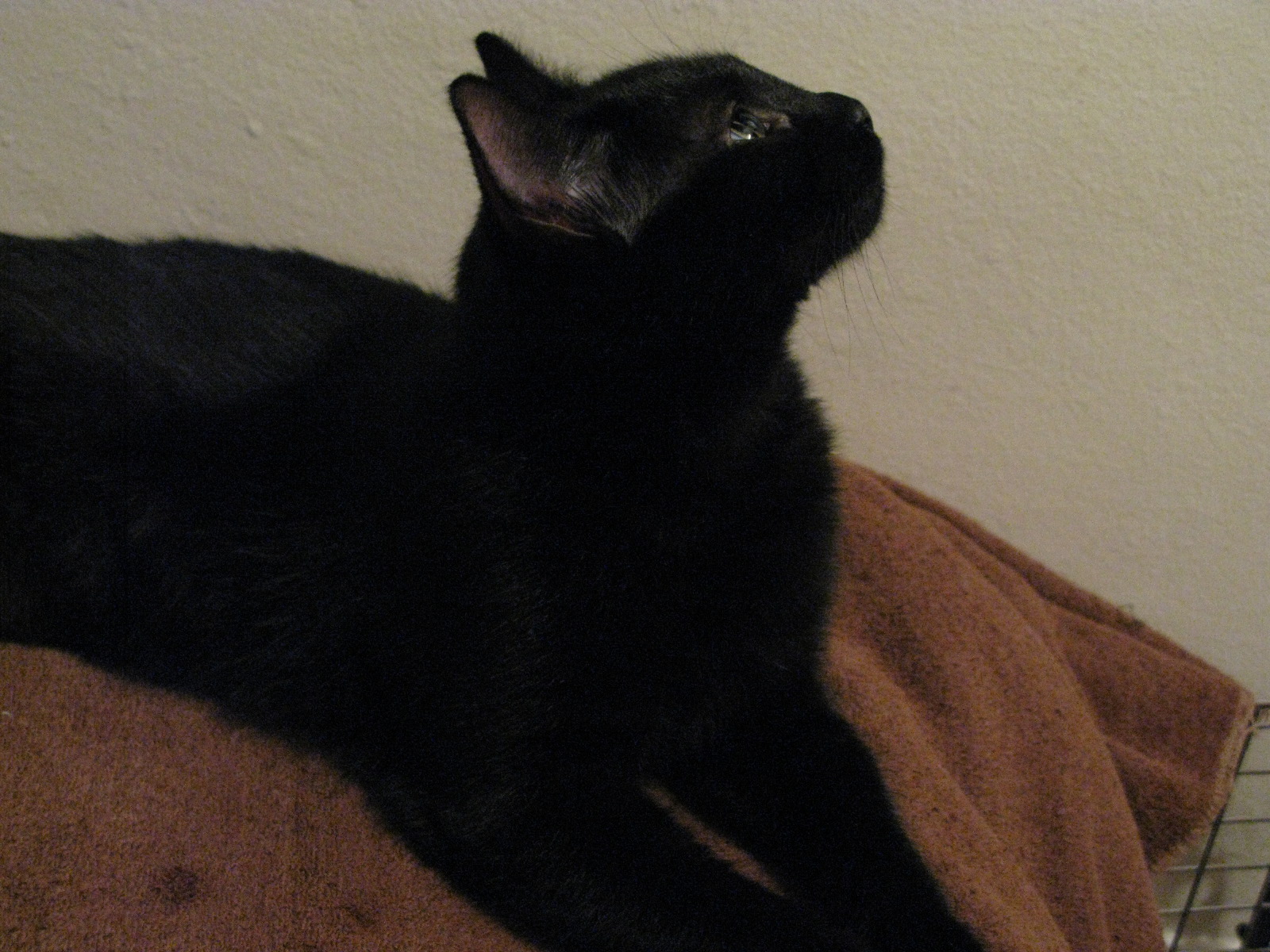
Shadow and Scruffy are being boarded at the vet this weekend, as I'll be in Pennsylvania to help my brother move. While they're there, Shadow will receive an indentification microchip, as her nature makes me worry that she may escape at some point. I don't have any type of vestibule or hallway between my living space and the outside world (I actually live in a tiny house with a main room, a cramped bathroom, and a tight kitchen, but somehow it seems easier to call it a studio apartment. House seems to suggest more than one room. More importantly, I rent the house, so I'm not really in a position to add a vestibule of any sort. [Digression over.])
The chip is really neat, though it's not a new concept. The idea is to attach a unique, indelible identifier to the cat (or dog, or wonder llama) so that, should it escape and be found, the ID can be compared to a database to find the animal's owner and reunite the two. Previously, and perhaps still, tattooed ID numbers were used - these were placed on the back of the animal's neck; the microchip version is injected in the same place; waving a wand over the animal's neck reveals the animal's ID number.
The vet's comment was that it unfortunately wasn't a tracking device, only an identification one (Kitty Lo-Jack would be really cool), but Big Brother issues aside, I still think this is pretty neat. And I am Big Brother, too, or Older Brother at least.
The chip is really neat, though it's not a new concept. The idea is to attach a unique, indelible identifier to the cat (or dog, or wonder llama) so that, should it escape and be found, the ID can be compared to a database to find the animal's owner and reunite the two. Previously, and perhaps still, tattooed ID numbers were used - these were placed on the back of the animal's neck; the microchip version is injected in the same place; waving a wand over the animal's neck reveals the animal's ID number.
The vet's comment was that it unfortunately wasn't a tracking device, only an identification one (Kitty Lo-Jack would be really cool), but Big Brother issues aside, I still think this is pretty neat. And I am Big Brother, too, or Older Brother at least.
Subscribe to:
Posts (Atom)